 ultimate-guide
How to Insure Luxury Florida Homes: 2026 Guide
Table of Contents
- Why Standard Policies Fall Short for Luxury Florida Homes
- What Defines High-Value Homeowners Insurance Requirements
- Coverage Essentials: Dwelling, Contents, and Fine Art Schedules
- Navigating Hurricane Deductibles and Coastal Risk
- Protecting Assets with Umbrella and Excess Liability Policies
- Tips for Lowering Florida Insurance Premiums Without Sacrificing Coverage
- How to Choose a Specialized Carrier for Your High-Value Property
- Get a Custom Quote for Your Luxury Home
- Frequently Asked Questions
Last Updated: September 8, 2026
Insuring a high-value property requires a fundamentally different approach than a standard homeowners policy, yet many owners of luxury Florida homes discover this only after a devastating loss. High-value homeowners insurance is a specialized category of coverage for properties whose reconstruction costs, contents, and liability exposures exceed standard policy limits. At Dehlinger Insurance, our team has spent over 38 years guiding Florida residents through this process, matching distinctive properties with carriers who understand coastal risk and bespoke coverage needs.
The gap between a standard policy and what your home requires often comes down to a single question: what happens when you need to rebuild? Most luxury homeowners are surprised to learn that a policy based on market value can leave them underinsured by hundreds of thousands of dollars. Below, we walk through the essential coverage layers, the nuances of hurricane deductibles, and the strategies that protect your property and broader financial portfolio.
Why Standard Policies Fall Short for Luxury Florida Homes
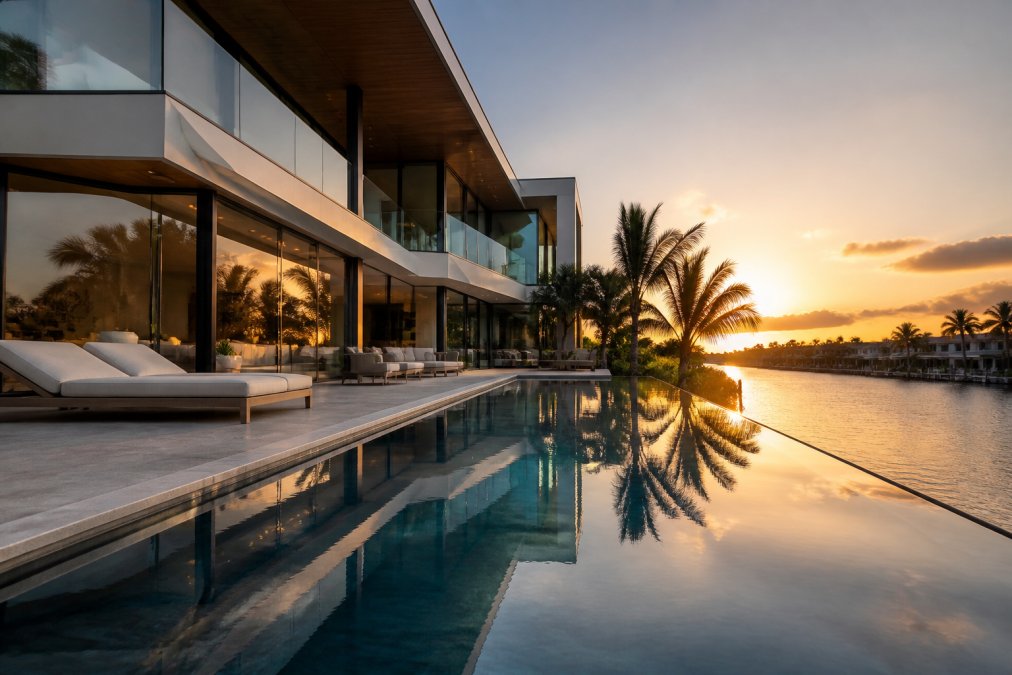
Standard homeowners policies are built for typical construction: tract homes, standard finishes, and off-the-shelf materials. Luxury Florida homes break that model in nearly every direction, from imported stone and custom millwork to impact-rated glass and smart home infrastructure. Standard dwelling coverage often fails to account for the true reconstruction cost of these bespoke features.
A common mistake is assuming your policy's dwelling limit reflects what it would actually cost to rebuild today. Standard policies frequently use replacement cost estimates that lag behind current construction pricing, specialized labor, and architect fees. For a luxury property, that gap can reach six figures quickly, leaving you personally responsible for the difference.
What Defines High-Value Homeowners Insurance Requirements
High-value homeowners insurance requirements differ from standard coverage in several measurable ways. Carriers in this space typically underwrite properties with reconstruction costs above a certain threshold, often starting around $750,000 or $1 million, and they offer policy limits that scale well beyond standard insurers. The underwriting approach, claims settlement, and coverage options all shift once you cross into this tier.
These specialized policies are built around the principle of indemnity, meaning you are made whole after a loss, not simply paid a capped amount. That philosophy shows up in features like guaranteed replacement cost, which covers the full expense of rebuilding your home regardless of the policy limit, and in broader contents coverage that recognizes the true value of your personal property.
Coverage Essentials: Dwelling, Contents, and Fine Art Schedules
A comprehensive high-value policy assembles several distinct layers of protection. Dwelling coverage pays to repair or rebuild the physical structure, contents coverage protects your personal property, and additional endorsements extend protection to items that exceed standard sublimits.
Guaranteed Replacement Cost vs. Market Value
The distinction between guaranteed replacement cost and market value is the single most important coverage decision you will make. Market value reflects what your home would sell for on the open market, including the land beneath it. Replacement cost reflects what it would actually cost to rebuild the structure today using comparable materials and craftsmanship. For luxury Florida homes, these figures often diverge dramatically.
Guaranteed replacement cost coverage ensures that if a covered loss destroys your home, the insurer pays to rebuild it fully, even if construction costs exceed your dwelling limit. This protection is essential when reconstruction cost rises sharply after a major storm, when labor and materials become scarce.
Scheduling Fine Art, Jewelry, and Collectibles
Standard policies impose strict sublimits on categories like jewelry, fine art, and collectibles, often capping coverage at a few thousand dollars per item. For owners of luxury Florida homes, those limits are grossly inadequate. Scheduling high-value items on a fine art schedule or personal articles floater provides agreed-value coverage, meaning you and the insurer agree on each item's value upfront.
The scheduling process begins with a professional appraisal for each item, documenting its condition, provenance, and current market value. This documentation must be current and thorough. Review your schedule annually, particularly as the art market fluctuates and collections evolve, to ensure your policy limits track the actual value of what you own.
Navigating Hurricane Deductibles and Coastal Risk
Hurricane deductibles operate differently from your standard policy deductible. A hurricane deductible is typically expressed as a percentage of your dwelling coverage, commonly ranging from 1% to 5%, rather than a flat dollar amount (floir.com). On a $2 million home, a 2% hurricane deductible means you are responsible for the first $40,000 of damage from a named storm.
The percentage you select directly influences your premium, with higher deductibles yielding lower annual costs. However, the trade-off deserves careful consideration: can you comfortably absorb a deductible that might reach six figures on a high-value property? Many owners of luxury Florida homes carry wind mitigation inspections that document features like hip roofs, impact-resistant windows, and reinforced roof-to-wall connections, which can qualify for premium credits.
Florida Office of Insurance Regulation guidance on hurricane deductibles explains that these deductibles apply specifically to losses caused by named storms, not all wind events. Understanding exactly when your hurricane deductible triggers, and how it interacts with your flood insurance, is essential to avoiding a coverage gap at the moment you need protection most.
Protecting Assets with Umbrella and Excess Liability Policies
Liability exposure for owners of luxury Florida homes extends well beyond what a standard policy provides. A guest injured on your property, a lawsuit stemming from a domestic employee, or liability arising from a secondary home can all threaten assets far beyond your primary policy's limits. Excess liability and umbrella policies provide an additional layer of protection, typically starting at $1 million and scaling upward to match your net worth.
Excess liability simply raises the limits of your underlying homeowners policy. An umbrella policy, by contrast, provides broader coverage, extending protection to situations not covered by your primary policy at all, such as certain personal injury claims or liability arising from activities away from your property. For high-net-worth individuals, an umbrella policy is often the more comprehensive choice.
The Integration Imperative: How Luxury Policies Sync with Your Wealth Plan
For a high-net-worth individual, a standalone umbrella policy is insufficient. The true value lies in the integration of your homeowners, auto, and umbrella policies into a single, coordinated risk management strategy. This is where the 'how-to' becomes critical.
The Underlying Limits Requirement: Umbrella carriers require your underlying homeowners and auto policies to carry specific minimum liability limits, typically $300,000 to $500,000 for auto and $300,000 for homeowners. If your primary policy limits are too low, you must increase them before the umbrella can attach. manage luxury home construction.
The 'Duty to Defend' and Legal Cost Coverage: A key differentiator of a high-value umbrella policy is its approach to legal defense. Standard umbrella policies often have a 'duty to defend' clause, meaning the insurer controls the defense. High-value carriers, however, may offer policies that provide for your own independent counsel if a conflict of interest arises.
Coverage for 'Personal Injury' and 'Worldwide' Liability: A robust umbrella policy extends beyond bodily injury and property damage. It covers 'personal injury' claims like libel, slander, and false arrest, and provides worldwide liability coverage, essential for a luxury homeowner who travels frequently or owns property abroad.
The Secondary Home Nuance: Many luxury owners have multiple properties. Your umbrella policy must be structured to cover all of your residences, your primary Florida home, a mountain retreat, and a coastal condo. Each property must have its own underlying homeowners policy with sufficient limits, and the umbrella must be endorsed to list all of them as 'insured locations.'
The Role of the Independent Agent in Coordination
This is where working with an experienced advisor matters most. At Dehlinger Insurance, we coordinate your homeowners, auto, and umbrella policies to ensure the coverage layers align properly. We review your entire risk profile, including your business interests, your household staff, and your personal activities, to determine the correct umbrella limit and the specific endorsements you need.
Tips for Lowering Florida Insurance Premiums Without Sacrificing Coverage
Most Florida homeowners assume that lowering premiums means accepting weaker protection, but several legitimate strategies reduce cost while maintaining comprehensive coverage. The most effective approach combines property improvements with smart policy structuring.
The Climate Resilience Angle: How Home Hardening Directly Lowers Premiums
In Florida, insurers are required to offer premium credits for features that reduce hurricane damage (flsenate.gov). These credits are not trivial; they can reduce your wind premium by 20% to 40% or more, depending on the features and the carrier.
A certified wind mitigation inspection (using the uniform Windstorm Mitigation Inspection Form) documents these features and provides the evidence carriers need to apply the credits. The most impactful upgrades for a luxury property are:
- Impact-Resistant Windows and Doors: Replacing standard glass with impact-rated glazing is often the single most expensive retrofit, but it also yields the largest premium credit. It also eliminates the need for plywood or shutters, which is a major convenience and safety advantage.
- Roof-to-Wall Connections: Upgrading from toe-nails to metal hurricane straps or clips is a structural improvement that significantly increases a home's ability to withstand uplift. This is a critical credit factor.
- Secondary Water Barrier: Adding a self-adhering membrane over the roof deck prevents water intrusion if the roof covering is torn off. This is a relatively low-cost upgrade that can qualify for a substantial credit.
- Roof Shape and Covering: A hip roof (sloped on all sides) is more aerodynamic than a gable roof. Replacing an older asphalt shingle roof with a new one that meets Florida Building Code (FBC) standards for wind resistance is a major underwriting and pricing factor.
The Financial Mechanics of a Retrofit
On a $2 million dwelling with a 2% hurricane deductible, your wind premium might be $10,000 annually. A combination of impact windows, a new FBC-compliant roof, and a secondary water barrier could easily qualify for a 30% credit, reducing that premium by $3,000 per year. Over a 10-year period, that's $30,000 in savings. Furthermore, these improvements can make your home insurable with carriers that might otherwise decline coverage due to an older roof or non-impact glass.
Beyond Hardening: Policy Structure and Credits
Beyond physical upgrades, several policy-level strategies can lower costs without cutting coverage:
- Review Your Contents Limits: Luxury homes often carry contents limits that are higher than necessary. A detailed home inventory can help you right-size this limit, potentially saving hundreds of dollars annually.
- Increase Your Wind Deductible Strategically: Moving from a 1% to a 2% hurricane deductible can lower your premium. The trade-off is a higher out-of-pocket cost if a named storm hits. For a high-net-worth individual who can absorb a $40,000 deductible, this can be a prudent way to save on annual premiums.
- Bundling and Loyalty: Bundling your homeowners, auto, and umbrella policies with a single carrier frequently unlocks multi-policy discounts. Maintaining a claims-free history also strengthens your negotiating position at renewal.
- Annual Policy Audit: Your coverage needs change as you renovate, acquire art, or change your lifestyle. A yearly review with an independent agent can identify redundant coverage or limits that no longer match your risk profile, ensuring you are not paying for protection you don't need.
How to Choose a Specialized Carrier for Your High-Value Property
Selecting the right carrier for your luxury Florida home requires evaluating more than just the premium quote. Specialized carriers in the high-value space differentiate themselves through claims handling, underwriting flexibility, and the depth of their coverage forms. A carrier that understands coastal risk and bespoke construction will respond differently when you file a claim.
Begin by examining each carrier's claims settlement philosophy. High-value carriers often assign a dedicated claims adjuster with experience in complex losses, and they may offer advanced loss settlement options that pay full replacement cost without depreciation. Review their financial strength ratings and their history of paying claims in Florida specifically.
The underwriting process for luxury coverage is more detailed than standard applications. Carriers will request comprehensive information about your home's construction, systems, and safety features, and they may require an inspection before binding coverage. This is where an experienced independent agency adds measurable value. Dehlinger Insurance maintains relationships with multiple top-tier carriers, allowing us to match your property's specific profile with an insurer whose underwriting appetite aligns with your needs.
Get a Custom Quote for Your Luxury Home
Securing the right coverage for your luxury Florida home begins with a thorough assessment of your property's reconstruction cost, your contents, and your liability exposure. Generic online quotes cannot account for the specialized features, coastal risk, and coverage layers that define high-value insurance.
The team at Dehlinger Insurance has served Florida residents for over 38 years, building relationships with carriers who specialize in high-value and coastal properties. We take the time to understand your home's construction, your collection, and your broader financial picture before recommending coverage.
Frequently Asked Questions
What defines a high-value home for insurance purposes?
A high-value home typically has a replacement cost above a certain threshold, often $750,000 or $1 million, depending on the carrier. The distinction goes beyond price. These homes often feature custom architecture, premium materials, and high-end finishes that cost significantly more to rebuild. Standard policies cap dwelling coverage and may not account for the specialized labor and materials required. Insurers specializing in luxury Florida homes use detailed appraisal and risk assessment to calculate accurate reconstruction costs, ensuring your policy limits reflect the true expense of rebuilding after a total loss.
How does hurricane deductible work for a luxury home policy?
A hurricane deductible is a separate, percentage-based deductible applied specifically to damage from named storms. Instead of a flat dollar amount, it is calculated as a percentage of your dwelling coverage, typically ranging from 1% to 5%. For a $2 million home, a 2% deductible means you pay the first $40,000. Choosing a higher hurricane deductible lowers your annual premium, but you must have cash reserves to cover that out-of-pocket cost. Wind mitigation inspections can help you qualify for credits that offset some of this expense.
Why do I need a separate flood insurance policy for my luxury Florida home?
Standard homeowners policies, including those for high-value properties, exclude flood damage. This includes storm surge from hurricanes, which is a major risk for coastal Florida homes. Flood insurance is a separate policy issued by the National Flood Insurance Program (NFIP) or private flood insurers. For luxury homes, NFIP coverage caps out at $250,000 for the dwelling and $100,000 for contents, which is far below the value of most high-end estates. A private flood policy can provide higher limits and coverage for items like bespoke furniture and artwork.
What are the high-value homeowners insurance requirements for a secondary home?
Insuring a secondary luxury home involves several distinct requirements. Many specialized carriers require the property to be secured with a monitored alarm system and have regular maintenance checks. You may need a higher liability limit, especially if you rent the property. Vacancy clauses are also common. If the home is unoccupied for more than 30 consecutive days, coverage may be suspended. Carriers often require you to have a property manager or caretaker to inspect the home regularly. Disclose the home's secondary status upfront to avoid coverage gaps and claims denials.
How can I lower my luxury home insurance premium in Florida?
Start with a wind mitigation inspection to document roof shape, construction materials, and opening protection. These features can earn significant discounts. Installing hurricane shutters or impact-resistant windows reduces your named storm risk. Bundling your home and auto policies with the same specialized carrier often yields a discount. Raising your hurricane deductible is another effective strategy. Reviewing your contents limit annually ensures you are not over-insuring items you no longer own. An independent agent can also shop multiple specialized carriers to find the best rate for your specific risk profile.
Protecting a luxury Florida home demands more than a standard policy; it requires a coordinated strategy that addresses dwelling coverage, contents, liability, and coastal risk. Contact Dehlinger Insurance today to discuss your high-value property and receive a custom quote that reflects its true worth. Our experienced team will help you secure the comprehensive protection your home deserves.