 ultimate-guide
What to Look for in Florida Property Insurance Policies
Table of Contents
- Why Standard Florida Property Insurance Policies Leave You Exposed
- How to Read Your Declarations Page for Florida Property Insurance Gaps
- Replacement Cost vs Actual Cash Value: Which Payout You Get
- Hurricane Deductible Explained: How Your Roof Claim Gets Priced
- Homeowners Insurance Policy Exclusions You Must Challenge Before Closing
- Wind Mitigation Credits and Premium Discounts That Pay for Inspections
- How to File a Claim Without Triggering Post-Claim Litigation Risks
- Conclusion: Your Pre-Season Policy Checklist
- Frequently Asked Questions
Last Updated: September 7, 2026
Most Florida homeowners discover their coverage gaps at the worst possible moment: standing in a flooded living room with a denied claim in hand. Deciding what to look for in florida property insurance policies is the most important financial review you will do this year. At Dehlinger Insurance, with over 38 years of experience, we have seen the same costly misunderstandings repeat across thousands of policies.
Why Standard Florida Property Insurance Policies Leave You Exposed
The gap between what homeowners believe they are covered for and what the policy actually pays is often staggering. Standard policies bundle several distinct coverages, but the limits rarely match the true replacement value of a home. When a total loss occurs and the dwelling limit is set too low, the shortfall comes directly out of your pocket. Many policies are written to a price point, not to the actual cost of rebuilding in your market, where construction costs, labor shortages, and updated building codes push rebuild prices higher than market value. Reviewing the dwelling coverage number against a current local rebuild estimate is the first step in closing that gap.
How to Read Your Declarations Page for Florida Property Insurance Gaps
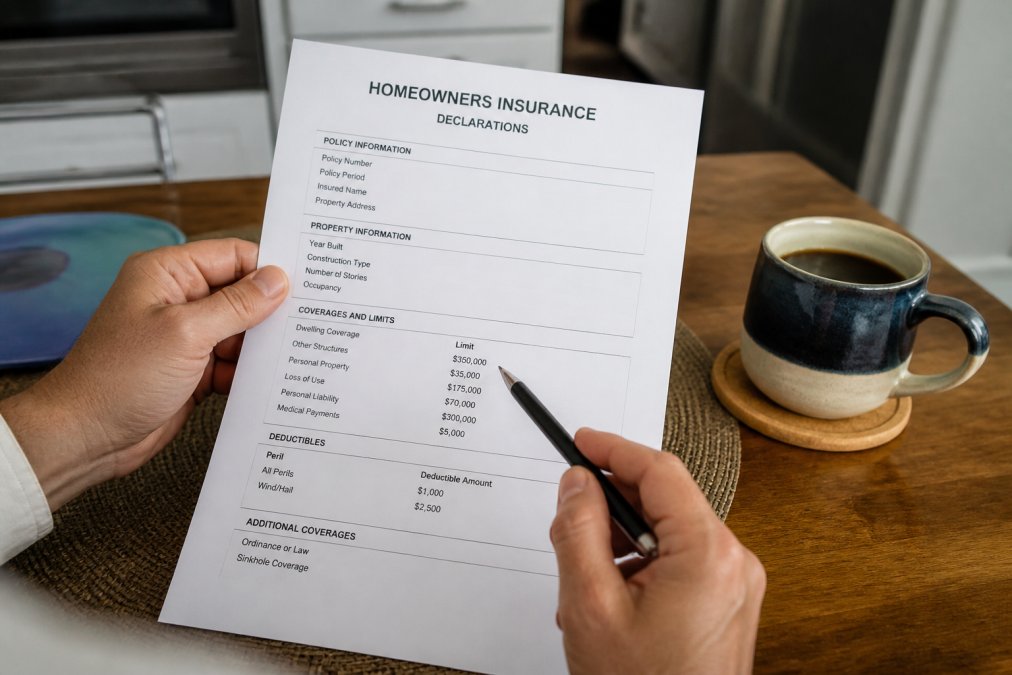
Your declarations page is the summary of everything your policy covers, and it deserves a line-by-line read. It lists your coverage limits, deductibles, and premium for each section, making it the fastest way to spot missing protection.
Decoding the 'Coverage A' Limit and Insurance-to-Value (ITV)
Start with the dwelling coverage figure (Coverage A). This should reflect the full replacement cost of the structure, not its market value, not your mortgage balance, but the actual cost to rebuild it today. In a high-inflation environment, this number can shift significantly year over year.
This is where the Insurance-to-Value (ITV) ratio becomes critical. ITV is the ratio of your Coverage A limit to the true replacement cost. A healthy policy carries a 100% ITV ratio. When your limit falls below 80% of the replacement cost, you trigger a 'coinsurance penalty' that reduces your claim payment proportionally.
Here is the mechanism: If your home costs $400,000 to rebuild, but you only carry $280,000 in Coverage A (a 70% ITV ratio), you are underinsured. If you suffer a $100,000 partial loss, the carrier applies the coinsurance formula: (Limit Carried / 80% of Replacement Cost) x Loss Amount. In this case: ($280,000 / $320,000) x $100,000 = $87,500. You are penalized $12,500.
To avoid this, compare your Coverage A limit against a current rebuild estimate from a local contractor, not a real estate appraisal. The [Florida Office of Insurance Regulation's guide to home insurance(/best-florida-home-insurance-2026) | floir.com] emphasizes that this is the policyholder's responsibility, not the carrier's.
The Hidden Details in Your Endorsements and Exclusions
The declarations page lists endorsements, the riders that modify your base policy. This is where coverage gaps are often hidden in plain sight. Look for these specific endorsements and understand what they do:
- Ordinance or Law (Coverage OL): This is not automatically included in standard dwelling coverage. It pays for the cost to demolish undamaged portions of your home and rebuild to current building codes. Without it, a partial loss can leave you with a structure that cannot be legally repaired.
- Personal Property Replacement Cost: Your base policy may value your belongings at Actual Cash Value (ACV), which deducts for depreciation. An endorsement switches this to Replacement Cost Coverage (RCV). The difference on a 10-year-old sofa is the difference between $200 and $800.
- Water Backup and Sump Discharge: Standard policies exclude water that backs up through sewers or drains. This endorsement adds coverage for that specific peril.
The Deductible Structure: More Than One Number
Florida policies are unique in their deductible structure. You will see a standard 'All Other Perils' deductible (often a flat $1,000 or $2,500) and a separate 'Hurricane' deductible, which is a percentage of your Coverage A limit (typically 1% to 5%).
On a $400,000 home, a 2% hurricane deductible is $8,000. But the trigger language is just as important as the percentage. The hurricane deductible applies only to damage caused by a 'named storm' as declared by the National Hurricane Center. Wind damage from a severe thunderstorm that is not a named storm falls under your lower, flat-dollar deductible.
The 'Law and Ordinance' and 'Building Code' Endorsements
Finally, verify that you have 'Law and Ordinance' coverage. This endorsement pays for the increased cost of construction to meet updated building codes after a covered loss. For example, if a hurricane damages 30% of your roof, local code may require you to bring the entire roof up to current wind-mitigation standards. The cost of that upgrade is not covered by standard dwelling coverage; without it, you are personally responsible for the difference, which can be substantial.
Replacement Cost vs Actual Cash Value: Which Payout You Get
Replacement cost coverage pays to repair or rebuild your home with materials of similar kind and quality, without deducting for depreciation. Actual cash value subtracts depreciation from the payout, meaning you receive the current market value of the damaged property, often far less than what you need to replace it.
The distinction matters most for a roof claim. A 15-year-old roof damaged in a storm is paid at its depreciated value under an actual cash value policy. With replacement cost coverage, the carrier pays what it costs to install a new roof today. The premium difference is usually modest, yet the payout difference can run into tens of thousands of dollars. insurance claim process.
Review the policy language carefully to confirm which valuation method applies to each section, and ask your agent to quote the cost of upgrading any actual cash value sections.
Hurricane Deductible Explained: How Your Roof Claim Gets Priced
A hurricane deductible is a separate, percentage-based deductible that applies specifically to damage caused by a named storm. Unlike the flat-dollar deductible for other claims, this one is calculated as a percentage of your dwelling coverage limit, typically ranging from 1% to 5%.
On a $300,000 home, a 2% hurricane deductible means you pay the first $6,000 of damage out of pocket; a 5% deductible pushes that to $15,000. The right balance depends on your cash reserves and premium savings.
Homeowners Insurance Policy Exclusions You Must Challenge Before Closing
Standard Florida homeowners policies exclude several perils that homeowners assume are covered. Flood damage from rising water or storm surge requires a separate flood insurance policy through the National Flood Insurance Program. Sinkhole coverage, despite its prevalence in Florida, is also excluded or severely limited, with catastrophic ground cover collapse often the only covered event.
The policy exclusions section deserves the same careful reading as the coverage limits. Look specifically for language around water damage, mold, and maintenance-related issues, since carriers frequently deny claims when they determine the damage resulted from gradual wear rather than a sudden event. The Florida Office of Insurance Regulation guidelines provide a useful baseline for understanding what standard policies must include and where carriers have flexibility to add exclusions.
Call Us and Get a Quote Today! →
Ordinance or Law Coverage and Building Code Upgrades
Ordinance or law coverage pays for the additional cost of rebuilding to current building codes after a covered loss. Without it, your policy only covers repairing the damaged portion to its pre-loss condition, leaving you to absorb the expense of bringing the entire structure up to code. After a major hurricane, local building departments frequently require upgrades to roof strapping, window impact resistance, and electrical systems, costs that only this coverage addresses.
Wind Mitigation Credits and Premium Discounts That Pay for Inspections
A wind mitigation inspection documents the features of your home that make it more resistant to hurricane damage, and the results can translate directly into premium discounts. Features such as hip roofs, roof-to-wall connections, impact-resistant windows, and proper roof deck attachment all qualify for credits under most carrier rating systems.
The inspection itself is a modest expense, but the Florida's wind mitigation credit framework can yield annual savings that far exceed the inspection cost. Homes built before 2002, when the Florida Building Code was significantly strengthened, often benefit the most since they may already have features that were not documented at the time of construction.
Many homes built in the 1990s have features like reinforced roof-to-wall connections that were installed voluntarily, and the discount applies every year the policy is in force.
How to File a Claim Without Triggering Post-Claim Litigation Risks
The claims process in Florida has become uniquely adversarial, a direct consequence of the state's litigation environment. For the policyholder, a claim is a process where your documentation and legal awareness determine the outcome.
The Assignment of Benefits (AOB) Trap
One of the most critical legal documents you may encounter is the Assignment of Benefits (AOB). This contract with a contractor, roofer, or public adjuster transfers your insurance claim rights to them, giving them the legal standing to negotiate with your carrier and file a lawsuit in your name if they disagree with the settlement. While AOBs can streamline the repair process, they have been a primary driver of litigation and premium increases. Florida's 2019 tort reform (SB 2A) curtailed the one-way attorney fee provision that made AOB lawsuits so lucrative, but the risk has not disappeared. Before signing any AOB, ask the contractor these specific questions:
- Will you waive my deductible? This is a red flag for fraud and can void your coverage.
- What is the exact scope of work, and does the AOB limit my financial liability if my insurance denies the claim?
- Does the AOB allow you to sue my insurance company without my explicit consent on each legal filing?
A better alternative is to pay the contractor directly and have them bill you, preserving your right to negotiate with the carrier yourself. If you are considering an AOB, consult with your insurance agent or an attorney first. The Florida Department of Financial Services guidance on AOBs provides a clear overview of your rights.
The 'Sworn Proof of Loss' and the 60-Day Rule
Your primary duty after a loss is to file a 'Sworn Proof of Loss', a formal, notarized document detailing the damage and your claim for payment. Florida law requires you to submit this within 60 days of the carrier's request. Missing this deadline can jeopardize your claim.
The Litigation Reality: What Happens When You Sue
If you do end up in litigation, understand the mechanics. Florida is a 'fault' state for insurance, meaning you must prove the carrier breached the contract. A 2022 legislative change eliminated the 'one-way attorney fee' statute for most property claims, meaning if you sue and lose, you could be responsible for the carrier's legal fees. Your goal should be to make your claim so well-documented and defensible that the carrier's adjuster knows a lawsuit would be a losing proposition. This means:
- Get independent estimates: Do not rely solely on the carrier's adjuster. Hire a licensed, independent public adjuster to prepare a detailed estimate of your own.
- Document every communication: Keep a log of every call, email, and letter with the carrier, including the date, time, and name of the person you spoke with.
- Understand the 'Reasonable and Necessary' standard: Your policy pays for repairs that are 'reasonable and necessary' to restore your home. Be prepared to justify every line item on your estimate.
Knowing your rights and the legal landscape before a loss occurs puts you in a stronger negotiating position. The Florida Office of Insurance Regulation consumer complaint process is a resource if you believe the carrier is acting in bad faith, but your own documentation is your first and best line of defense.
Conclusion: Your Pre-Season Policy Checklist
Reviewing your florida property insurance policy before hurricane season is not a one-time task. It is an annual discipline that should happen at the same time every year, ideally several months before the peak of the season.
Confirm that ordinance or law coverage is in place, schedule a wind mitigation inspection to capture every available discount, and document your home thoroughly so that if you do need to file a claim, you have the evidence to support it.
| Policy Element | What to Check | Why It Matters |
|---|---|---|
| Dwelling coverage | Matches current rebuild cost | Prevents coinsurance penalties |
| Valuation method | Replacement cost vs. actual cash value | Determines your actual payout |
| Hurricane deductible | Percentage and trigger definition | Know your out-of-pocket exposure |
| Ordinance or law coverage | Included or add-on | Covers building code upgrade costs |
| Wind mitigation credits | Documented features | Unlocks annual premium discounts |
Navigating these decisions is exactly where an experienced local agency earns its keep. Dehlinger Insurance has spent over 38 years helping Florida homeowners secure coverage that actually protects them, including specialized policies for older homes that many carriers decline. Our relationships with multiple top insurance carriers mean we can compare options across the market to find coverage that fits both your home and your budget. Call us and get a quote today, and go into the next storm season with a policy you understand and trust.
Frequently Asked Questions
What is the 80% rule in property insurance?
The 80% rule is a coinsurance clause requiring you to insure your home for at least 80% of its replacement cost. If you insure below that threshold, your insurer reduces claim payouts proportionally, even for partial damage. In Florida property insurance, this makes accurate insurance-to-value critical. A roof replacement that should cost $20,000 might pay only $16,000 if you underinsure. Review your dwelling coverage limit each year against current construction costs, not your purchase price.
Are windstorm and flood coverage included in standard Florida property insurance policies?
Flood damage is excluded from standard homeowners policies and requires a separate flood policy. Windstorm coverage is typically included, but it comes with a special hurricane deductible, which is a percentage of your dwelling coverage rather than a flat dollar amount. This means a $300,000 home with a 5% hurricane deductible pays $15,000 out of pocket before wind damage coverage begins. Verify both your hurricane deductible percentage and whether your policy includes a separate windstorm exclusion.
What is the difference between replacement cost and actual cash value?
Replacement cost coverage pays to rebuild your home or replace belongings at current prices without deducting depreciation. Actual cash value pays the depreciated amount, meaning a 10-year-old roof might pay only a fraction of its replacement cost. For Florida property insurance, replacement cost for your dwelling is essential. For personal property, replacement cost endorsements cost more but prevent large out-of-pocket gaps. Always check whether your policy uses replacement cost or actual cash value for both your home structure and your belongings.
How do I verify if an insurance carrier is licensed to write Florida property insurance?
You can verify a carrier's license through your state's Office of Insurance Regulation website. Search the company name in the agent or company search tool to confirm active status and check for any enforcement actions. Also review the carrier's financial strength ratings from independent agencies like AM Best. A licensed carrier with a weak rating may struggle to pay claims after a major hurricane. Your agent can help you verify both licensing and financial stability before you bind coverage.