 listicle
Best Florida Home Insurance Alternatives in 2026
Table of Contents
- Florida Home Insurance Alternatives: Quick Comparison
- How We Evaluated Florida Home Insurance Alternatives
- Citizens Property Insurance Florida: The Insurer of Last Resort
- Private Market Alternatives: Kin, Slide, and Specialty Carriers
- Wind-Only and Surplus Lines: Coverage for High-Risk Properties
- How to Lower Florida Home Insurance Premiums
- Self-Insuring a Home in Florida: Risks and Realities
- Which Alternative Is Right for You?
Last Updated: August 9, 2026
Florida Home Insurance Alternatives: Quick Comparison
Finding affordable home insurance in Florida has become a real challenge. If you've been rejected by major carriers, watched your premiums spike, or simply want to explore options beyond the usual suspects, you're not alone. At Dehlinger Insurance, we work with Florida homeowners facing these exact pressures every day, helping them navigate alternatives that actually fit their situation and budget.
The insurance landscape in Florida has shifted dramatically. Private insurers have pulled back from coastal areas, Citizens Property Insurance has swelled to over 500,000 policyholders, and homeowners are left scrambling. But alternatives exist, and some work better than you'd expect depending on your property type, location, and risk profile.
Quick Picks:
- Best for most Florida homeowners: Dehlinger Insurance, personalized guidance to find coverage from multiple carriers, specialized for older homes and high-risk properties
- Insurer of last resort: Citizens Property Insurance Corporation, when private options run out
- Tech-forward alternative: Kin Insurance or Slide Insurance, direct-to-consumer options available in high-risk areas
- Wind-only coverage: Geovera or other surplus lines carriers, for coastal properties needing focused hurricane protection
- Self-insurance: High-net-worth individuals with substantial liquid assets and no mortgage requirement
How We Evaluated Florida Home Insurance Alternatives
We assessed each option across five core criteria: availability in Florida's high-risk zones, coverage comprehensiveness, claims processing reputation, premium competitiveness, and suitability for different property types.
Availability matters most. Many national insurers won't write new policies in Florida anymore. We focused on carriers and programs that actively serve the state, especially in coastal and high-risk areas where options are genuinely limited.
Coverage gaps are where many Florida homeowners get blindsided. A policy that looks affordable might exclude wind damage, cap personal property coverage, or require massive deductibles. We evaluated what each alternative actually covers versus what you'd need to supplement elsewhere.
Claims processing speed and fairness became critical after recent hurricane seasons. We looked at complaint ratios, settlement timelines, and whether carriers are known for denying claims or fighting payouts.

Finally, we matched alternatives to specific situations. A luxury waterfront home needs different coverage than an inland 1980s ranch. A property owner with no mortgage has different options than someone with a lender's requirements.
Citizens Property Insurance Florida: The Insurer of Last Resort
Citizens Property Insurance Corporation exists to provide coverage when the private market won't. If three or more insurers have denied you, or if you've been non-renewed by your current carrier, Citizens is your backstop.
Citizens covers dwelling, personal property, liability, and medical payments. For coastal properties, they offer windstorm coverage, the critical piece for Florida homes. Rates are set by the Florida Office of Insurance Regulation based on location, property age, construction type, and hurricane exposure.
The honest truth: Citizens is designed as a safety net, not a first choice. Policyholders have reported delays in claims processing, low settlement offers, and denials requiring appeals. Coverage options are more limited than private carriers, and rates tend to run higher because Citizens assumes the riskiest properties that private insurers rejected.
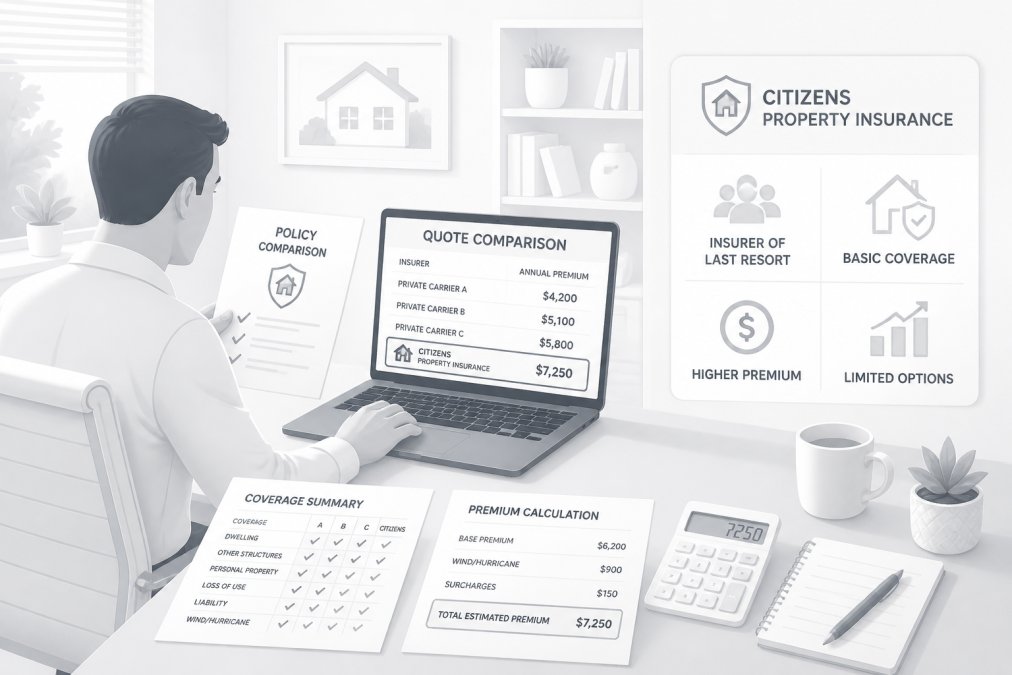
But Citizens serves a critical function. For properties in high-risk coastal zones or older homes that can't find private coverage, Citizens ensures you're not completely uninsured. You can apply online at citizensfla.com or through an insurance agent. Citizens will conduct a property inspection and approval usually takes a few weeks.
Many Florida homeowners treat Citizens as temporary coverage while they work with an agent like Dehlinger Insurance to find private market alternatives.
Private Market Alternatives: Kin, Slide, and Specialty Carriers
A handful of private insurers still actively write policies in Florida's high-risk markets, using technology and specialized underwriting to manage risk differently than traditional insurers.
Kin Insurance operates a direct-to-consumer model, cutting out the agent middleman to reduce overhead. They focus specifically on catastrophe-prone states like Florida. Customers who switched to Kin reported saving an average of $989 per year in a 2023-2024 survey. The trade-off: some customers report rate increases at renewal, and claims processing complaints surface occasionally.
Slide Insurance launched in 2021 with a focus on Florida and South Carolina. They use AI and advanced data analysis to personalize coverage and pricing. Slide holds an A-rating from Demotech for financial strength and includes a vetted contractor network for emergency repairs. The limitation: they only serve two states, and some customers have complained about slow claims processing on major damage claims.
Both represent a newer insurance model: technology-enabled, direct-to-consumer, and willing to underwrite properties that traditional carriers avoid. They're worth getting quotes from, especially if you're comfortable with digital interactions.
Specialty carriers, regional or niche insurers focused on specific risks, also operate in Florida. These carriers often have relationships with local agents who understand Florida's unique challenges. Dehlinger Insurance works with multiple specialty carriers to find the right fit for each client. If you have an older home, a unique property type, or specific coverage needs, specialty carriers often provide better options than big national names.
Wind-Only and Surplus Lines: Coverage for High-Risk Properties
When standard homeowners policies become unavailable, wind-only and surplus lines insurance fill the gap.
Wind-only insurance covers damage from hurricanes, tropical storms, and high winds. These policies don't cover fire, theft, water damage unrelated to wind, or other standard perils. You'd need separate coverage for those risks. The advantage: wind-only policies are often cheaper because they're narrowly focused. The deductible is typically 2%, 5%, or 10% of your home's insured value, which can be substantial on a $500,000 home.
Wind-only makes sense if you already have other coverage in place and want to layer in affordable hurricane protection. It doesn't work as a standalone solution.
Surplus lines insurance comes from carriers not licensed to write standard policies in Florida. These unauthorized insurers can cover risks that admitted insurers won't touch. The process requires a specialized surplus lines agent. Surplus lines policies don't have the protection of the Florida Insurance Guaranty Act, if the insurer becomes insolvent, you're not protected like you would be with an admitted carrier.
Surplus lines premiums vary dramatically based on risk. A property with significant hurricane exposure, older roof, or poor maintenance history will pay substantially more. But for homeowners who've exhausted other options, surplus lines provide actual coverage.
How to Lower Florida Home Insurance Premiums
If you're paying Florida insurance rates, you know they're climbing. Several legitimate strategies can reduce your premiums.
Home hardening is the most effective approach. Carriers offer discounts for hurricane mitigation improvements: roof reinforcement, impact-resistant windows, reinforced garage doors, hurricane shutters, and improved drainage. A new roof rated for high wind resistance often generates a 10-15% discount. Impact-resistant windows and shutters add another 10-15%. These improvements also increase your home's resale value and genuinely protect your property.
Call Us and Get a Quote Today! →
Bundling home and auto insurance with the same carrier typically saves 10-20% on your total premium. If you're insuring separately, consolidating can unlock significant savings.
Raising your deductible lowers your premium immediately. Moving from a $500 deductible to $1,000 might save 10-15%. The trade-off is higher out-of-pocket costs if you file a claim.
Shopping annually matters in Florida's volatile market. Carriers adjust rates constantly based on recent loss experience. Many Florida homeowners find better rates by switching every two or three years. Dehlinger Insurance monitors this for clients, alerting them when better options emerge.
Improving your credit score can reduce premiums with some carriers who use credit-based insurance scores. Paying bills on time and reducing debt can lower your insurance costs.
The reality: Florida premiums are structurally higher than most states because risk is genuinely higher. You can't eliminate that risk premium, but you can reduce it through mitigation and smart shopping.
Self-Insuring a Home in Florida: Risks and Realities
Self-insurance, setting aside personal savings to cover potential losses instead of buying an insurance policy, sounds appealing in theory. No monthly premiums, no dealing with claims adjusters, complete control over your funds.
In practice, it's extremely risky for most Florida homeowners. A single hurricane can cause $200,000 to $500,000+ in damage to a typical home. Most Americans can't cover a $1,000 unexpected expense, let alone a six-figure property loss.
There's also a legal barrier: if you have a mortgage, your lender requires homeowners insurance. Self-insurance doesn't satisfy that requirement.
For high-net-worth individuals with substantial liquid assets and no mortgage, self-insurance becomes theoretically viable. You're betting that major damage won't occur during your ownership period. Even wealthy homeowners typically carry insurance for liability protection. If someone is injured on your property and sues, liability coverage protects your assets. Self-insurance doesn't provide that protection.
Self-insurance might work as a partial strategy with high deductibles and large emergency reserves, but full self-insurance is unrealistic for most Florida property owners.
| Strategy | Best For | Key Trade-off |
|---|---|---|
| Full homeowners policy | Most Florida homeowners | Monthly premium cost |
| Wind-only + other coverage | Coastal properties with separate fire/flood coverage | Gaps in non-wind coverage |
| Citizens Property Insurance | Properties rejected by private market | Limited coverage, higher rates |
| Self-insurance | High-net-worth, no mortgage | Catastrophic loss exposure |
| Kin/Slide direct carriers | Tech-comfortable homeowners in high-risk areas | Limited claims support |
Which Alternative Is Right for You?
Choosing an insurance alternative depends on your specific situation.
If you have a standard home in a moderate-risk area and haven't been denied coverage: Private market options through an agent like Dehlinger Insurance are your best bet. You'll get competitive rates, personalized guidance, and access to multiple carriers.
If you've been rejected by multiple private insurers: Citizens Property Insurance is your legal backstop. But before accepting Citizens' rates, work with an agent to explore specialty carriers and surplus lines options. Dehlinger Insurance has successfully placed older homes and high-risk properties that other agents said were uninsurable.
If you're in a coastal high-risk zone and want the lowest possible premium: Consider layering wind-only coverage with flood insurance and fire coverage. This approach can cost less than comprehensive homeowners insurance while covering the perils that actually threaten coastal properties.
If you're tech-savvy and want to avoid agent involvement: Kin or Slide might work if you're comfortable with digital interactions. Get quotes from both. Be aware that initial savings sometimes reverse at renewal.
If you have a luxury home or unique property: Work with an agent experienced in high-value properties. Dehlinger Insurance specializes in luxury homes and properties requiring specialized coverage. Standard policies and online platforms often undervalue high-end properties.
If you're struggling with affordability: Home hardening improvements generate the biggest premium reductions. These improvements also increase your home's value and resilience. The insurance savings often justify the upfront cost within a few years.
Finding the right insurance alternative in Florida requires understanding your actual options, not just accepting the first quote that comes through. Whether you're exploring Citizens Property Insurance, specialty carriers, wind-only coverage, or direct-to-consumer platforms, the goal is the same: adequate protection at a price that fits your budget.
Dehlinger Insurance has spent over 38 years helping Florida residents navigate this exact challenge. Our team works with multiple top-tier carriers to find coverage for older homes, high-risk properties, and homeowners who've been rejected elsewhere. We handle the shopping, the comparisons, and the ongoing monitoring so you don't have to. Call us and get a quote today, we'll show you what's actually available for your situation.
Frequently Asked Questions
What is Citizens Property Insurance Florida and why would I need it?
Citizens Property Insurance Corporation is Florida's insurer of last resort, providing coverage when private insurers deny your application. It offers windstorm coverage, dwelling protection, and liability insurance to homeowners in high-risk areas or with hard-to-insure properties. While it ensures access to essential coverage, Citizens policies often cost more and provide less flexibility than private market options. Most residents use Citizens only after exhausting private alternatives.
How can I lower my Florida home insurance premiums?
Several strategies reduce your costs: install hurricane shutters, reinforce your roof, upgrade to impact-resistant windows, and maintain your home's structural integrity. Bundle home and auto policies for discounts. Increase your deductible if you can afford higher out-of-pocket costs. Work with an independent agent who represents multiple carriers to find competitive rates. Review your coverage annually, as your risk profile may improve over time, qualifying you for better rates.
Is self-insuring a home in Florida a realistic option?
Self-insurance, setting aside personal savings instead of buying a policy, is extremely risky in Florida. Most mortgage lenders legally require homeowners insurance, making this option unavailable for financed properties. Catastrophic losses from hurricanes can exceed $500,000, far beyond what most households can absorb. Unless you own your home outright, have substantial liquid assets, and own a low-value property, self-insurance exposes you to financial ruin. Traditional or alternative policies provide far better protection.
What are wind-only insurance policies and who should consider them?
Wind-only policies cover damage from hurricanes, tornadoes, and strong winds, the most common source of major losses in Florida. They do not cover flooding, fire, theft, or other perils, so you need separate flood insurance and other coverage. These policies work best for homeowners with other coverage in place or those in coastal areas facing severe wind risk. Deductibles are typically 2-10% of your home's insured value, making them more affordable than comprehensive policies for wind-specific protection.
Can I get homeowners insurance for an older Florida home?
Yes, but it's more challenging. Older homes face higher underwriting scrutiny due to roof age, electrical systems, and structural concerns. Dehlinger Insurance specializes in placing older homes with carriers that accept them, using relationships with multiple insurers to find solutions when standard companies decline. Citizens Property Insurance also serves older homes. Roof condition, recent updates, and mitigation improvements significantly improve your chances of approval and lower premiums.
This article was written using GrandRanker