 listicle
Get Auto Insurance Quote Florida 2026: Full Guide
Table of Contents
- How to Get an Auto Insurance Quote in Florida 2026
- Florida Minimum Auto Insurance Requirements Every Driver Must Know
- Factors Affecting Car Insurance Rates in Florida
- Cheapest Car Insurance Florida 2026: Provider Comparison
- Discounts That Actually Lower Your Florida Auto Insurance Premium
- Post-Accident Rate Transparency and Insurance for Non-Owner Drivers
- Why Florida Residents Get an Auto Insurance Quote Through a Local Agent
- Conclusion
Last Updated: August 3, 2026
Florida drivers pay some of the highest auto insurance premiums in the country. At Dehlinger Insurance, we've spent over 38 years helping Florida residents compare carriers and secure coverage that fits their budget. Below, we'll show you exactly how Florida's no-fault laws affect your rate, which providers are competing hardest for your business, and how to stop overpaying by your next renewal.
Florida is a no-fault state with mandatory Personal Injury Protection requirements, a litigious claims environment, and weather risk that makes underwriters nervous year-round. That combination pushes premium rates higher than the national average for most driver profiles.
How to Get an Auto Insurance Quote in Florida 2026
Getting an accurate auto insurance quote in Florida starts with knowing what information underwriters need. Carriers use specific inputs to build your driver profile and calculate risk.
What Information You Need Before Requesting a Quote
Before you request a quote, gather the following:
- Driver information: Full legal name, date of birth, driver's license number, and driving record for all household drivers
- Vehicle details: Year, make, model, VIN, current mileage, and whether the vehicle is financed or leased
- Coverage history: Your current insurer, policy expiration date, and any lapses in coverage
- Accident and violation history: At-fault accidents, traffic violations, and DUI convictions from the past three to five years
- Garaging address: Where the vehicle is primarily parked, which affects risk assessment based on local claim frequency
Your credit-based insurance score matters in Florida. Pulling your own credit report before quoting gives you a chance to dispute errors before they cost you money.
Digital-First vs. Traditional Agent: Which Claims Process Works Better for You
Digital-first carriers like GEICO and Progressive offer simplified online quoting and mobile app claims filing, which works well for straightforward accidents. The gap shows up in complex claims: disputed liability, total loss disputes, or situations involving uninsured motorist coverage. A traditional local agent has direct carrier relationships and can advocate on your behalf in ways an app cannot. For Florida drivers dealing with high storm frequency or coverage questions, that human layer matters.
Florida Minimum Auto Insurance Requirements Every Driver Must Know
Florida's minimum auto insurance requirements are set by state law, and failing to maintain them results in license suspension, registration suspension, and reinstatement fees. Florida is one of the few states that does NOT require bodily injury liability as part of its state-mandated minimums.
Understanding PIP and PDL Coverage in a No-Fault State
Personal Injury Protection (PIP) is coverage that pays for your own medical expenses and lost wages after an accident, regardless of who caused it. Florida law requires a minimum of $10,000 in PIP coverage for all registered vehicle owners, as documented by the Florida Department of Highway Safety and Motor Vehicles insurance requirements.
Property Damage Liability (PDL) is coverage that pays for damage you cause to another person's property in an accident. Florida requires a minimum of $10,000 in PDL coverage.
Because Florida is a no-fault state, your own PIP coverage pays your medical bills first, regardless of fault. Florida's insurance market remains one of the most litigious in the country, which is a primary driver of elevated premium rates statewide.
Most financially responsible drivers carry bodily injury liability voluntarily, along with uninsured motorist coverage. Florida has one of the highest rates of uninsured drivers in the nation, according to Insurance Research Council uninsured motorists report.
Factors Affecting Car Insurance Rates in Florida
Florida's rate environment is shaped by hurricane exposure, dense urban traffic, fraud history, and the state's legal climate.
How Your Credit-Based Insurance Score and Driving Record Impact Premiums
Your driving record is the single most direct input into your premium calculation. At-fault accidents, speeding tickets, and DUI convictions each carry a surcharge that varies by carrier and severity. A DUI conviction in Florida can more than double your annual rate, and the surcharge typically stays on your policy for three to five years.
Your credit-based insurance score operates as a secondary risk signal. Florida permits its use, and most major carriers apply it. A lower credit score correlates statistically with higher claim frequency, which translates to higher premiums. Improving your credit score before policy renewal is one of the few ways to reduce your rate without changing your coverage.
Other underwriting factors that affect your Florida premium:
- Vehicle classification: Sports cars, luxury vehicles, and high-theft models carry higher collision and comprehensive rates
- Annual mileage: Higher mileage increases exposure frequency
- Age and experience: Young drivers under 25 pay significantly more
- Coverage limits and deductible selection: Higher deductibles lower your monthly premium but increase out-of-pocket costs after a claim
EV-Specific Insurance: What Florida Electric Vehicle Owners Pay More For
Electric vehicle insurance in Florida costs more than comparable gas-powered vehicles. Repair costs are higher because EV components, particularly battery systems, require specialized technicians and parts. Labor rates for EV-certified repair facilities run higher than standard shops.
Florida's heat accelerates battery degradation, and comprehensive coverage claims involving battery damage are more complex to adjudicate. Some carriers have introduced EV-specific endorsements to address battery replacement coverage gaps. If you own an EV, ask specifically about battery coverage limits and whether your carrier uses OEM or aftermarket parts for repairs.
Cheapest Car Insurance Florida 2026: Provider Comparison
Finding the cheapest car insurance Florida 2026 requires comparing both minimum coverage and full coverage rates, because the carrier that wins on minimum coverage often isn't the same one that wins on full coverage.
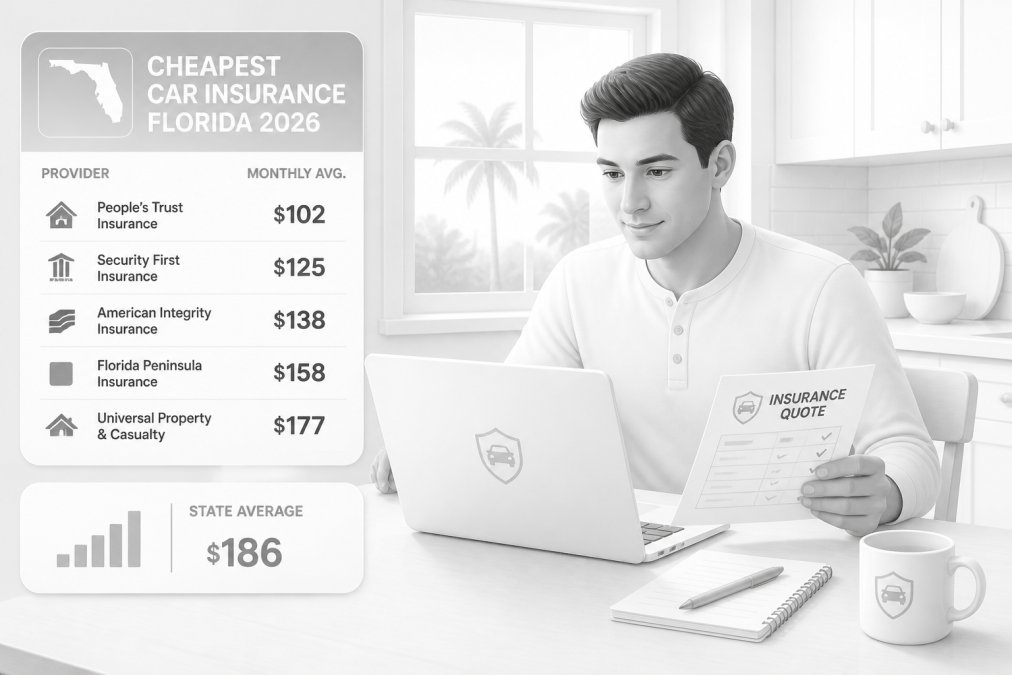
Minimum Coverage Rates by Provider
| Provider | Est. Monthly (Min. Coverage) | Best For | Notable Feature |
|---|---|---|---|
| USAA | $36/mo | Military members and families | SafePilot telematics, up to 30% off |
| State Farm | $45/mo | Good drivers seeking low base rates | Personal Price Plan, large agent network |
| Travelers | $51/mo | Teen drivers and seniors | Gap insurance available |
| Nationwide | $60/mo | Low-mileage drivers | SmartMiles pay-per-mile program |
| The General | $103/mo | High-risk drivers, SR-22/FR-44 filers | Flexible payment plans, bilingual support |
| Allstate | $109/mo | Drivers wanting telematics savings | Drivewise up to 30% savings |
| Liberty Mutual | $115/mo | Customizable coverage buyers | RightTrack program |
Note: USAA is available only to military members, veterans, and eligible family members.
Full Coverage Rates and What They Include
Full coverage refers to a combination of collision coverage, comprehensive coverage, and liability limits above the state-mandated minimums. Most lenders require full coverage on financed or leased vehicles.
- GEICO averages around $203/month for full coverage in Florida and offers a DriveEasy telematics program that can reduce that rate for safe drivers
- Progressive averages around $165/month for liability-only and offers the Snapshot program, which personalizes rates based on actual driving behavior with savings up to 30%
- State Farm remains competitive on full coverage and offers significant bundling discounts when you combine auto with renters or homeowners insurance
If your vehicle is totaled in a storm and you carry only PDL and PIP, you receive nothing for your vehicle. Comprehensive coverage is what pays for hurricane and flood damage, which is not a theoretical risk in Florida.
Discounts That Actually Lower Your Florida Auto Insurance Premium
Most drivers accept the first quoted rate without asking which discounts they qualify for.
Discounts that consistently appear across Florida's major carriers:
- Multi-policy discount: Bundling auto with home, renters, or umbrella insurance typically produces meaningful savings
- Safe driver / accident-free discount: Most carriers reward three or more years without an at-fault accident
- Telematics programs: GEICO's DriveEasy, Progressive's Snapshot, Allstate's Drivewise, and Nationwide's SmartRide all offer discounts tied to actual driving behavior, with savings up to 30-40%
- Good student discount: Available for full-time students maintaining a B average or better
- Defensive driving course: Completing an approved course can qualify for a rate reduction
- Anti-theft device discount: Vehicles equipped with factory or aftermarket anti-theft systems qualify at most carriers
- Pay-in-full discount: Paying your six-month or annual premium upfront typically reduces the total cost
Post-Accident Rate Transparency and Insurance for Non-Owner Drivers
Post-accident rate transparency is understanding exactly how much your premium will increase after an at-fault accident before you file a claim. For minor accidents where the repair cost is close to your deductible, paying out of pocket and preserving your clean driving record is often the better financial decision. The Florida Office of Insurance Regulation consumer resources provides guidance on policyholder rights, including the right to request rate information from your carrier.
Insurance for non-owner drivers provides liability coverage for drivers who don't own a vehicle but regularly drive borrowed or rented cars. It's particularly relevant for Florida residents who use car-sharing services, drivers whose license was suspended and need SR-22 or FR-44 financial responsibility filings, and young adults who drive family members' vehicles regularly. Non-owner policies don't include collision or comprehensive coverage since there's no owned vehicle to cover.
Why Florida Residents Get an Auto Insurance Quote Through a Local Agent
The case for working with a local independent agent comes down to access to multiple carriers through a single conversation.

Online quoting tools are efficient for simple profiles but struggle with complexity: older vehicles, homes bundled with auto, high-value properties, drivers with prior violations, or households with multiple drivers at different risk tiers. A local agent can run your profile across multiple top-tier carriers simultaneously, identify discount stacking opportunities that automated systems miss, and explain coverage differences in plain language.
Dehlinger Insurance has served Florida residents for over 38 years, working with multiple top-tier carriers to match clients with coverage that fits their actual financial situation. For Spanish-speaking Florida residents, working with an agency that provides bilingual service removes a significant barrier. Having an agent who can walk through coverage details, exclusions, and claims procedures in your preferred language is a functional necessity for making informed decisions.
The question isn't whether personalized service costs more. The question is whether a few minutes on a comparison website actually gets you the best rate for your specific profile, or whether you're leaving carrier-specific discounts and bundling opportunities on the table.
Frequently Asked Questions
What are the minimum auto insurance requirements in Florida for 2026?
Florida law requires all registered vehicle owners to carry at least $10,000 in Personal Injury Protection (PIP) and $10,000 in Property Damage Liability (PDL). Florida operates as a no-fault state, meaning your PIP coverage pays your medical expenses regardless of who caused the accident. These are state-mandated minimums; most drivers benefit from carrying higher coverage limits and adding uninsured motorist coverage, since Florida has one of the highest rates of uninsured drivers in the country.
How can I get a free auto insurance quote in Florida?
Getting a Florida auto insurance quote starts with gathering your driver's license number, vehicle identification number (VIN), current odometer reading, and your accident and traffic violation history. You can request quotes online through carrier websites or by calling a local independent agent like Dehlinger Insurance, who shops multiple top-tier carriers on your behalf. Working with an independent agent often surfaces better rates and coverage options than going to a single carrier directly, especially if your driver profile is complex.
Which companies offer the cheapest car insurance in Florida for 2026?
Based on available rate data, USAA offers the lowest minimum coverage averages for eligible military members and their families. State Farm and Travelers are frequently among the most affordable options for the general public at the minimum coverage level. For full coverage, GEICO and Progressive are competitive, though rates vary significantly based on your driving record, credit-based insurance score, vehicle classification, and ZIP code. An independent agent can compare multiple carriers simultaneously to find your best rate.
How does a traffic violation or accident history affect my Florida auto insurance rate?
Florida insurers treat accident history and traffic violations as major underwriting factors during risk assessment. A single at-fault accident can raise your annual rate substantially at policy renewal, and the increase typically stays on your record for three to five years. DUIs carry the steepest penalties, often requiring an FR-44 filing with higher liability limits than the state minimum. Maintaining a clean driving record over time is one of the most reliable ways to lower your monthly premium and improve your discount eligibility.
Does Florida require insurance if I drive but do not own a car?
Non-owner drivers in Florida are not required by the state to carry their own policy if they do not own or register a vehicle. However, if you regularly borrow or rent vehicles, a non-owner auto insurance policy provides liability coverage that protects you when the vehicle owner's policy limits are exhausted. It also helps maintain continuous coverage, which prevents a coverage gap that insurers treat as a risk factor and use to raise future premium rates when you do purchase a vehicle.
Florida's auto insurance market is genuinely complex, and the drivers who pay the most are usually the ones who stopped comparing after their first policy. Dehlinger Insurance brings over 38 years of Florida-specific experience, relationships with multiple top-tier carriers, and affordable payment plan options that make it easier to maintain the coverage you actually need. Call Us and Get a Quote Today.
This article was written using GrandRanker