 How-to
7 Florida Home Insurance Discounts for Security Systems
Quick Summary
Florida homeowners can lower home insurance premiums with security systems, but the discount depends on the insurer, the system type and documentation. Monitored systems usually earn the largest credits when you can prove an active monitoring contract. Ask your carrier what it recognizes before you buy.
- Monitored systems generally qualify for larger discounts than unmonitored ones.
- Proof such as a monitoring contract and installation certificate is usually required.
- Notify your insurer right away if monitoring lapses or you change alarm companies.
- Security discounts and wind-mitigation credits are separate and can both apply.
- Compare the quoted credit net of annual monitoring costs before installing.
Table of Contents
- How Florida Home Insurance Discounts for Security Systems Work
- Does an Alarm System Reduce Home Insurance Premiums?
- Monitored Versus Unmonitored Systems: Which Qualifies for a Discount
- Home Insurance Discount for Monitored Alarm: Eligibility and Proof
- Ring Security System Insurance Discount: Does a DIY Camera Setup Count?
- Security Discounts Versus Florida Wind-Mitigation Credits
- How to Ask Your Insurer About a Security System Discount
- Calculating Whether a Security System Pays for Itself Before You Install
- Frequently Asked Questions
How Florida Home Insurance Discounts for Security Systems Work
Last Updated: November 17, 2026
Florida homeowners can often lower their premiums by installing security systems, but the discount is not automatic. Each insurer sets its own rules, so the savings depend on your carrier, your system and your documentation.
A security discount is a reduction in your premium for taking steps that make your home less likely to be burgled or damaged. Insurers reward these steps because they reduce the risk of claims. Most discounts recognize alarms, monitored systems and some protective devices, though each carrier defines these categories differently.
The discount works in three parts. First, the insurer must recognize the type of device you have. Second, you must prove it is installed and working. Third, you must tell the insurer about it, since most carriers will not apply a credit they do not know about.
Keep in mind that a discount is a percentage of your premium, not a fixed dollar amount. Its value rises and falls with your base rate.
Does an Alarm System Reduce Home Insurance Premiums?
Yes, in many cases an alarm system can lower your home insurance premium, but the reduction depends on the insurer and the type of alarm. Some carriers offer a discount for any alarm that connects to a central station, while others reward only monitored systems with professional oversight.
A common mistake is assuming that any alarm qualifies. Many insurers want evidence of a specific system, such as a certificate of installation or a monitoring contract. Without that proof, the credit may never be applied, even though the device is in your home.
Check your current policy declarations page and ask your agent whether the carrier recognizes your alarm. Get the answer in writing before you spend money on installation.
Monitored Versus Unmonitored Systems: Which Qualifies for a Discount
Monitored systems generally qualify for larger discounts than unmonitored ones. A monitored system sends alerts to a central station that can dispatch emergency responders. An unmonitored system only sounds a local alarm, which gives insurers less assurance that a break-in will be reported quickly.
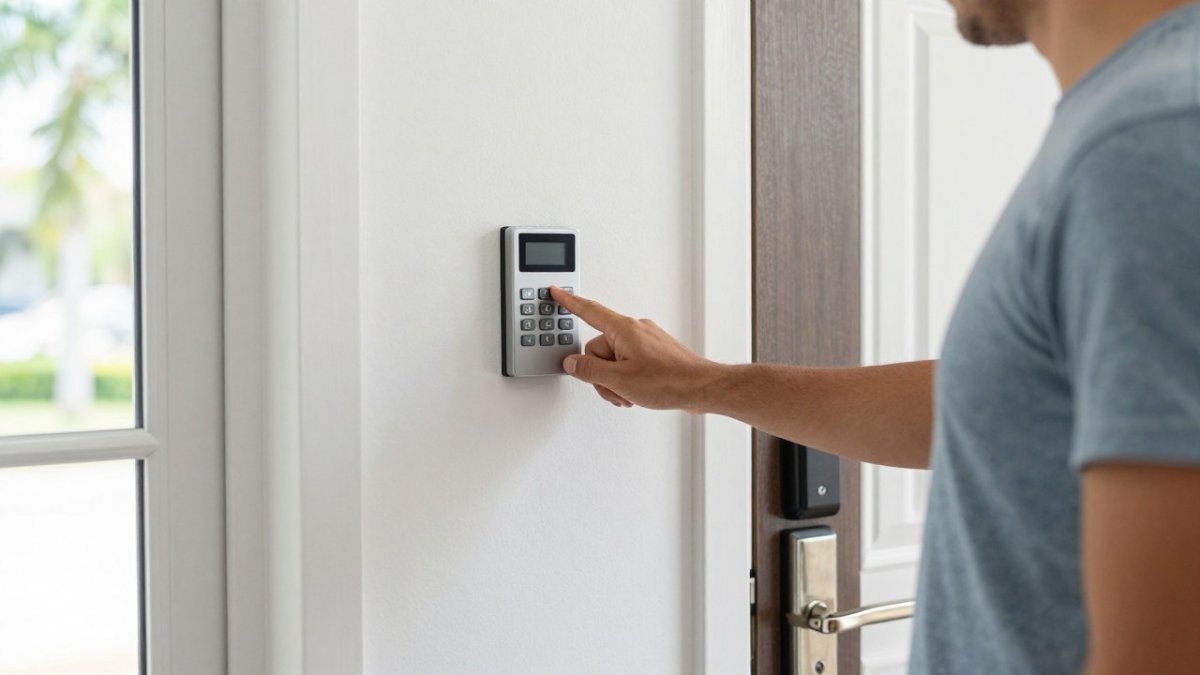
The difference matters at renewal time. Insurers look at whether the monitoring contract is active, so a cancelled service can cost you the credit.
- Monitored systems: usually eligible for the largest discounts, when you provide proof of an active contract
- Unmonitored systems: may qualify for smaller credits or none, depending on the carrier
- Smart devices without monitoring: often treated as unmonitored unless your insurer says otherwise
Fire and Smoke Protection Devices
Fire and smoke protection devices can also earn credits. Monitored fire alarms, smoke detectors and fire extinguishers are common examples. Many insurers pair these with theft devices in a single discount category, so ask whether a fire-only system counts on its own.
Sprinkler systems are often treated separately and may carry their own credit, so confirm this with your carrier before assuming a sprinkler installation will lower your premium.
The article distinguishes how monitored and unmonitored systems are typically treated for discounts.
| System type | Typical discount | Key requirement |
|---|---|---|
| Monitored system | Usually the largest discount | Active monitoring contract with proof |
| Unmonitored system | May be smaller or none | Depends on the carrier |
| Smart devices without monitoring | Often treated as unmonitored | Confirm with your insurer |
Home Insurance Discount for Monitored Alarm: Eligibility and Proof
Eligibility for a monitored alarm discount usually comes down to two tests: the system must be professionally monitored by a central station, and you must be able to prove it on demand. Insurers do not take the device on faith. They want a paper trail that ties the equipment to your address and shows the monitoring service is active.
A practical documentation checklist for a monitored alarm discount:
- Monitoring contract or certificate. A current agreement with the central station, showing your name, the protected address, the start date and the renewal date. A one-page certificate from the monitoring company is often enough, but confirm the format your carrier accepts.
- Installation invoice or certificate. A receipt or installer certificate that identifies the panel, sensors and any fire devices, with the installation date. This is how the insurer confirms the system is actually in the home.
- Central station information. The monitoring company's name, phone number and, where requested, its central station identifier. Some carriers verify monitoring directly with the station.
- Renewal or active-status disclosure. Proof that the contract has not lapsed, such as a recent billing statement or a renewal notice.
- Policyholder attestation. Some insurers accept a signed statement describing the system, but most still require at least one third-party document.
Keep these records in one folder, paper and digital, and refresh them at each renewal. Underwriting and renewal reviews are when proof is most often requested.
Watch out: a monitoring contract that auto-renews on a different cycle than your policy can create a gap in proof. If the contract renews in March and your policy renews in January, ask the monitoring company for a current certificate before the policy renewal so the dates line up.
When you change alarm companies, upgrade equipment or cancel service, tell your insurer right away. A lapse in monitoring can remove the discount mid-policy.
A common pattern is for insurers to apply the discount at the next renewal rather than mid-term. Ask whether a mid-term endorsement is allowed and what effective date the carrier will use, so you are not surprised when the credit appears months later than expected.
Ring Security System Insurance Discount: Does a DIY Camera Setup Count?
Many homeowners install Ring cameras and doorbells and wonder whether they qualify. The answer depends on whether the system includes professional monitoring and whether your carrier recognizes doorbell or camera devices at all.
A self-monitored camera setup often falls outside the standard monitored-alarm category. Some insurers may still give a small credit for smart home devices, so ask directly rather than assume. Describe your exact setup, including any monitoring plan, when you request a quote.
Security Discounts Versus Florida Wind-Mitigation Credits
Security discounts and wind-mitigation credits are separate. Wind mitigation addresses storm damage through features such as roof shape, roof-deck attachment and opening protection. Security discounts address theft and fire risk. You can qualify for both, and insurers generally apply them independently.
Do not confuse the two when comparing quotes. If a wind-mitigation credit is denied, you can read how to appeal a denied wind mitigation insurance credit. A carrier that advertises a large wind-mitigation credit may still offer a modest security discount, and the reverse is also true. Ask for each credit to be itemized so you can see what you are actually receiving.
How to Ask Your Insurer About a Security System Discount
Asking the right question gets you the right answer. Start by calling your agent and stating the exact system you have, including the brand, whether it is monitored and when it was installed.
Use this script when you call:
"I have a [brand] monitored alarm installed on [date] with [monitoring company]. Does your company offer a security system discount for this system, and what documents do you need to apply it?"
Follow up in writing. Email your agent a copy of the monitoring contract and ask for confirmation that the discount is on your policy. Review your next declarations page to make sure the credit appears.
Some insurers will not apply a discount until your next renewal, so ask about timing as well. If your insurer has already refused or non-renewed your policy, see how to dispute a Florida home insurance non-renewal. You may be able to request an endorsement mid-term, but the carrier decides whether to allow it.
Calculating Whether a Security System Pays for Itself Before You Install
Most guides stop at the formula. The useful version separates one-time costs from recurring costs, then compares the result against the credit your carrier will actually quote, not a national average. That is the gap this section fills: a cost-benefit method you can run with real numbers from your own policy and your own installer.
Start by listing the costs in two buckets:
- One-time costs: equipment, installation, activation and any permit fee. These are paid once and should be spread over the expected life of the system when you compare them with annual savings.
- Recurring costs: the monthly monitoring fee multiplied by 12, plus any annual service or cellular backup charge. These repeat every year and directly offset the annual premium credit.
Then calculate net annual savings:
Net annual savings = Annual premium credit − Annual monitoring cost
And payback period on the one-time cost:
Payback period (years) = One-time cost ÷ Net annual savings
Three practical steps make the math trustworthy:
- Get the credit quoted before you buy. Ask your agent for the specific dollar or percentage credit your carrier will apply to your policy, in writing. A generic "up to" figure from a brochure is not a quote.
- Compare at least two carriers. Security discounts are not standardized. One carrier may reward only central-station monitoring, another may add a separate credit for fire devices, and a third may offer nothing for cameras. The same system can produce very different credits.
- Run the numbers at your actual premium. A percentage credit is worth more on a higher base rate. A 10% credit on a $2,000 policy is $200 per year; the same credit on a $4,000 policy is $400. Use your declarations page, not a sample policy.
Watch out: a large advertised discount can shrink after underwriting. If the credit is contingent on a specific monitoring tier or device list, confirm those details before installation, because upgrading later to meet the carrier's definition can erase the savings you counted on.
Finally, treat the premium credit as one benefit among several. The decision may still make sense because of the protection itself, but the financial case should rest on the quoted credit net of monitoring costs, not on a headline percentage. Ask Dehlinger Insurance for a current quote and a written credit estimate before you commit to a system.
Frequently Asked Questions
Do I get a discount on home insurance with a security system?
Many Florida insurers offer a discount when you have an approved security system, but the amount and rules vary by carrier. Some insurers require a monitored system with a central station, while others accept certain self-monitored or smart devices. Discounts are often a percentage of the premium, so the savings depend on your policy and coverage. Ask your agent which systems your insurer recognizes, and request written confirmation of the discount before you pay for installation.
Does Ring count as a security system for insurance?
Ring products may qualify with some insurers, but many carriers look for a monitored alarm system that connects to a central monitoring station. A standalone camera or doorbell may not meet the requirement. Each insurer sets its own eligibility rules, so confirm in writing whether your specific Ring setup qualifies and what proof of installation or monitoring they need before you expect the discount on your renewal.
What documents do I need to request a security system discount?
Insurers usually ask for an installation certificate or invoice from the security company, the monitoring contract, and the name of the monitoring provider. Some request a signed form or photos of installed devices. Keep your monitoring agreement current and notify your insurer if the service is canceled, since a lapse can end the discount. Having these records ready speeds up approval and protects your savings at renewal.
Can smoke alarms or water-leak sensors qualify for home insurance discounts?
Some insurers give credits for smoke detectors, fire alarms, and water-leak sensors, especially when they are monitored or connected to a central service. Standard battery smoke alarms may earn little or no credit. Deadbolts and similar protective devices are sometimes rewarded separately. Check your insurer's list of qualifying devices, and remember that each credit is set by the carrier rather than a universal rule.